
Shipping terms are the backbone of any international trade agreement, clearly outlining the duties, costs, and risks for both the seller and buyer during cargo transportation. A key term in this lexicon is EXW, or Ex Works. Considering EXW for your shipping needs? Our article is here to shed light on this term, breaking it down into digestible, key aspects to help you grasp its nuances and make informed decisions for your business dealings.
What Is EXW Meaning in Shipping?
EXW, short for Ex-Works, is a pivotal shipping term you need to know. It essentially means the seller’s only job is to make the goods available at their premises, like a factory or warehouse. Once you get the goods from there, they’re yours – including all the risks and costs that come with them.
Let’s say you’re buying cups from Yiwu, China, and you need to get them to your warehouse in Los Angeles, USA. Under EXW, you’re in charge of the entire shipping process. This means:
- Coordinating with a freight forwarder to move your cargo from the seller’s spot to your warehouse. This includes everything from pick-up at Yiwu to delivery in Los Angeles, whether by air or sea.
- Covering all shipping-related costs, including various transit expenses.
- Managing export customs declarations and fees, plus handling import customs clearance, duties, and taxes back in the USA.
- Bearing the risk for any loss or damage during the journey.
The biggest challenge? Handling the export declarations. This can be a tricky part of EXW, but you can negotiate with your seller for assistance in making these declarations, with you covering the fees.
Also, it’s crucial to clarify who’s handling the customs declaration and under whose company name it will be made. Typically, Chinese sellers prefer using their title for a potential tax refund. If you’re declaring yourself, ensure the seller provides accurate information to avoid customs clearance hiccups and additional costs, especially during random inspections.
Remember, the seller should also supply essential documents like the Bill of Lading, packing list, invoice, and Certificate of Origin to facilitate a smooth process.
What Is EXW Price?
When navigating the waters of international trade, it’s crucial to understand how pricing works. Say a seller covers shipping fees, customs declaration charges, and other related expenses. Naturally, these costs will be factored into your product’s price. Imagine a product originally costs $2. Once these additional fees are added, the unit price might jump to $5.
In contrast, under EXW (Ex Works) terms, the seller’s financial responsibilities end at their warehouse door. The EXW price essentially reflects the product’s raw manufacturing cost. So, if you’re comparing product prices between two factories, asking for the EXW price gives you the truest cost comparison.
Here’s a key point: if you agree to an EXW deal, sellers often require full payment before shipping. Why? Because once those goods exit their warehouse, they’re entirely in your hands, out of the seller’s control. To safeguard their interests, sellers prefer to have the payment settled before the goods become your responsibility.
| ZingSourcing helps you get competitive product prices from our reliable suppliers. |
When to Use EXW?
Importing products from abroad? If you’re well-versed in the exporting country’s logistics or have a local presence there, EXW (Ex Works) might be your ideal choice. This option simplifies handling customs clearance and shipping on the exporter’s turf. Plus, it allows you to tailor the transportation method for cost-efficiency and logistical precision.
Planning to ship via express couriers like FedEx or UPS? Then, asking the seller for the EXW Price is wise. This way, the courier can directly pick up the goods from the seller’s location.
Yet, in reality, many importers lean towards terms like FOB, CIF, or DDP. This shift is especially true for those unfamiliar with the exporter’s country. Navigating the complexities of collecting goods from the seller’s factory and managing export formalities can be daunting. These alternative shipping terms offer the convenience of having sellers manage these aspects, albeit at a cost included in the product’s price.
To put this into perspective, let’s revisit our example: purchasing cups from a factory in Yiwu, China, for your warehouse in Los Angeles, USA. Choosing between EXW and other shipping terms hinges on your familiarity with the export landscape and your capacity to manage logistics independently.
EXW vs FCA
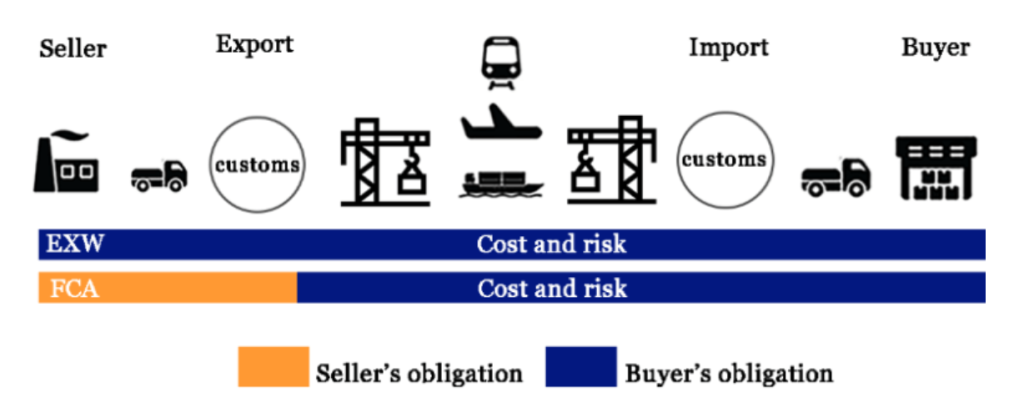
FCA, or Free Carrier, is a term where the seller takes on a bit more responsibility. They not only deliver your goods to a predetermined location, often your freight forwarder’s warehouse, but also handle the export customs declarations. Think of it as the seller extending a helping hand up to a specific point in the journey of your goods.
EXW, or Ex Works, on the other hand, is more hands-off for the seller. Here, they’re only required to have your goods ready at their factory. It’s then up to your truck to pick them up. But here’s a twist: in real-world trade, you might strike a deal with the seller to transport the goods to your freight forwarder’s warehouse, which may sound similar to FCA.
However, the key difference lies in the nitty-gritty of customs. Under EXW, whether the goods are picked up at the factory or your designated warehouse, the seller won’t deal with export customs declarations. In FCA, that’s part of their job.
In essence, with FCA, the seller covers the cost from their factory to the agreed delivery spot and the export declaration fee. These expenses get factored into the final FCA price you’re quoted.
FCA price = EXW price + shipping cost to the delivery location + export declaration fees
EXW vs FOB
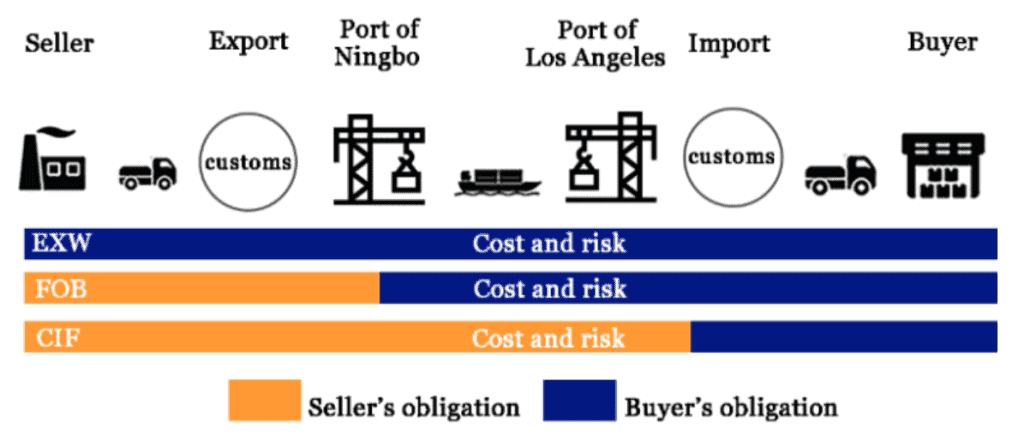
When comparing FCA and FOB, the role of the seller under FOB terms is more comprehensive. Not only do they manage and pay for the export declaration, but they also transport your goods to the nearest port, say the Port of Ningbo, and hand them over to your freight forwarder. From that point, the responsibility and all related costs shift to you.
The crux of the difference between EXW and FOB lies in the seller’s obligations. Under FOB, the seller is tasked with handling the export procedures, shipping the goods to a nearby port, and absorbing the associated costs and risks until that handover. Consequently, the FOB price you’re quoted will reflect these additional seller responsibilities and expenses.
FOB price = EXW price + shipping cost from the factory to Ningbo Port + export customs declaration costs
If you’re seasoned in buying and have a trusted freight forwarder to manage shipments from China to the US, FOB (Free On Board) is an ideal choice for you. It aligns perfectly with the expertise of an experienced buyer like you, ensuring a smooth shipping process.
EXW vs CIF
When opting for FOB, the seller’s responsibilities extend beyond just getting your goods to Ningbo Port. They’re also tasked with shipping them all the way to the Port of Los Angeles, covering the freight costs, and securing cargo insurance. Essentially, the seller bears the risks and costs right up to the Port of Los Angeles. After that, it’s all on you, the buyer, to handle the costs and risks for the remainder of the journey.
So the CIF quotation you get is:
CIF price = EXW price + Export declaration costs + shipping cost from the factory to Port of Los Angeles + cargo insurance
As a new buyer, if arranging shipping from Ningbo Port to the Port of Los Angeles seems daunting, CIF (Cost, Insurance, and Freight) is your go-to option. With CIF, your role simplifies to just finding a local freight forwarder in your city. They’ll take care of collecting and delivering your goods right to your doorstep.
FOB (Free On Board) and CIF (Cost, Insurance, and Freight) stand as the pillars of international trade, frequently at the heart of countless transactions. For you, the savvy buyer, delving deeper into these terms isn’t just recommended, it’s essential. Understanding their nuances can be a game-changer in navigating the complex waters of global trading.
| ZingSourcing can help you ship under FOB and CIF. |
EXW vs DDP
Choosing EXW (Ex Works) means embracing maximum responsibility and risk. You’re in charge of the entire shipping process, from the seller’s factory to your doorstep. Contrast this with DDP (Delivered Duty Paid), which is its polar opposite. Under DDP, the seller takes the reins, handling all transport, customs clearance, duties, and associated costs and risks, from their factory right to your door. This ease of DDP frees you up, allowing you to focus more on running your store efficiently, without the logistics hassle that comes with EXW.
DDP price = EXW price + shipping cost from factory to your door + import and export customs clearance fees + import duties and taxes
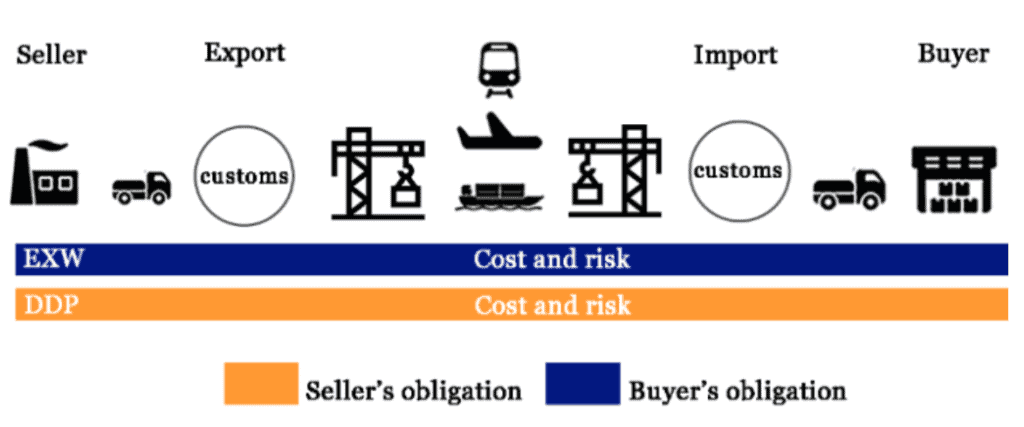
Lacking shipping resources or simply not keen on dealing with shipping hassles? DDP (Delivered Duty Paid) might be your ideal choice. It’s a hassle-free option where your seller manages the entire door-to-door delivery. However, ensure your seller is equipped to offer such comprehensive service. Alternatively, there’s DDU (Delivered Duty Unpaid) – similar to DDP, but with a key distinction: under DDU, you’re responsible for handling the import duties and taxes yourself.
| ZingSourcing can help you ship from door to door. |
Summary
When sizing up the total cost of importing products from China, it’s crucial to look beyond just the seller’s quote. The real expense story unfolds from the seller’s location right to your doorstep. Remember, import duties and the transportation cost from your country’s port to your warehouse can significantly inflate your budget. Shipping terms like EXW, FOB, and CIF often don’t cover these expenses. Given the complexity of these cost details, it’s wise to have a chat with your seller, freight forwarder, or sourcing agent for a clearer financial picture.
The End
We hope this article has shed light on EXW and how it stands apart from other shipping terms, equipping you with the knowledge to make the best choice for your business. Got questions? Drop us a comment below – we’re here to help.
At ZingSourcing, we pride ourselves on being a frontrunner in sourcing from China. Our expertise covers everything from procurement and customization to product quality inspection and shipping. We’re committed to providing top-notch services and competitive pricing. Need a hand with importing from China? Don’t hesitate to CONTACT US. Let’s make your importing journey smooth and successful.
| Further Reading about Incoterms What is CPT? What is CIP? What is DAT? |