
Alibaba Incoterms is a set of international trade terms used to clarify the responsibilities, costs and risk sharing between buyers and sellers during the transportation of goods. These provisions were developed by the International Chamber of Commerce (ICC) with the aim of streamlining global trade processes.
Alibaba Incoterms covers the entire transportation process from the place where the goods are sold to the destination, including cargo shipping, insurance, import and export customs clearance, etc., helping buyers and sellers to clearly understand their obligations and responsibilities when conducting cross-border transactions.
What are Trade Terms?
Trade terms, also known as Incoterms (International Commercial Terms), are standardized set of contractual sales terms widely used in international commercial transactions. They define the responsibilities of buyers and sellers for the delivery of goods under sales contracts, including who is responsible for the cost and risk at various points during the transportation process.
Definition of Incoterms Newest
The newest version of Incoterms, known as Incoterms 2020, is a set of 11 rules defined by the International Chamber of Commerce (ICC) to guide international and domestic trade contracts. Incoterms 2020 specifies the delivery terms, and clarifies the division of responsibilities between the buyer and seller in terms of freight charges, insurance, loading and unloading, and customs clearance.
Let us look at the recognizable terms as outlined in the incoterms newest.
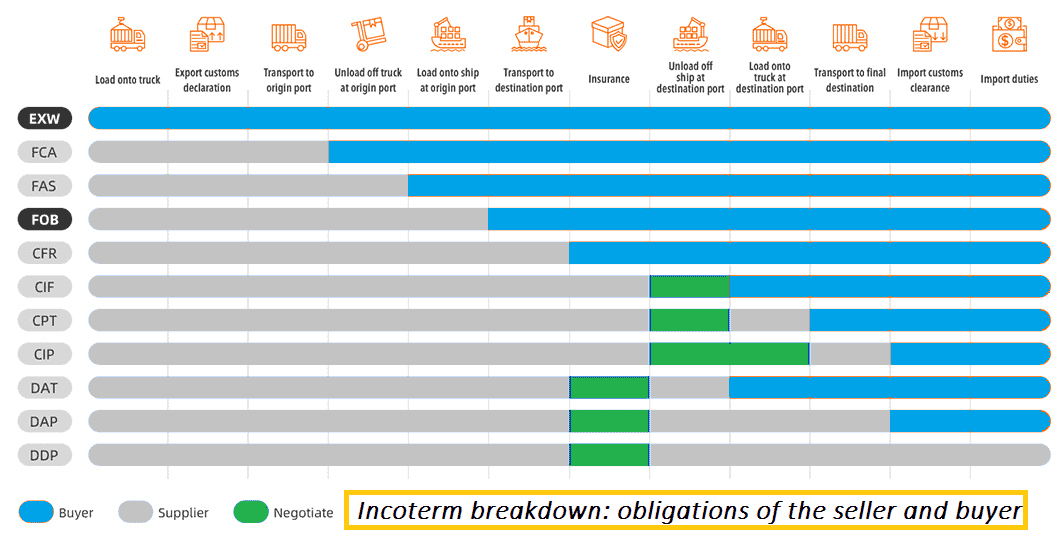
Responsibilities Related to Incoterms
Responsibilities related to Incoterms vary based on the specific term agreed upon by the buyer and seller. Generally, these responsibilities can be categorized into several key areas:
- Delivery of Goods: Specifies where the goods will be delivered from the seller to the buyer. It can range from the seller’s premises to the buyer’s designated location.
- Transportation Costs: Defines who is responsible for the transportation costs. Depending on the Incoterm, this responsibility can shift from the seller to the buyer at a designated point in the journey.
- Risk Transfer: Indicates when the risk of loss or damage to the goods transfers from the seller to the buyer. This point varies among the different Incoterms.
- Customs Clearance: Outlines who handles and pays for the export and import customs clearance and related duties and taxes.
- Insurance: Specifies who is responsible for insuring the goods during transportation. Some terms require the seller to obtain insurance, while others place this responsibility on the buyer.
- Loading and Unloading: Determines who is responsible for the costs and risks associated with loading and unloading the goods. This can depend on the chosen Incoterm and the designated location for the transfer of goods.
- Documentation: Identifies who is responsible for providing the necessary shipping and export/import documents.
Incoterms Groups
Incoterms can be divided into four groups based on the first letter of the term, each group having its own characteristics and specifying different levels of responsibility for the seller and buyer:
Group E (Departure)
- EXW (Ex Works): The seller makes the goods available at their premises, or another named place. The buyer is responsible for all costs and risks involved in taking the goods from the seller’s location to the destination.
Group F (Main Carriage Unpaid by Seller)
- FCA (Free Carrier): The seller delivers the goods, cleared for export, to the carrier chosen by the buyer at the seller’s premises or another named place.
- FAS (Free Alongside Ship): The seller places the goods alongside the ship at the named port of shipment, with the buyer assuming all risks and costs from that point forward.
- FOB (Free On Board): The seller loads the goods on board the vessel nominated by the buyer at the named port of shipment. Risk passes to the buyer once the goods are on board.
Group C (Main Carriage Paid by Seller)
- CFR (Cost and Freight): The seller must pay the costs and freight necessary to bring the goods to the named port of destination, but the risk transfers to the buyer once the goods are loaded onto the ship.
- CIF (Cost, Insurance, and Freight): Similar to CFR, but the seller also has to procure marine insurance against the buyer’s risk of loss or damage to the goods during the carriage.
- CPT (Carriage Paid To): The seller pays for the carriage of the goods to the named destination, but the risk transfers to the buyer when the goods are handed over to the first carrier.
- CIP (Carriage and Insurance Paid to): The seller also pays for insurance, in addition to the carriage of goods to the named destination.
Group D (Arrival)
- DAP (Delivered At Place): The seller delivers the goods, ready for unloading from the arriving means of transport, to a named place of destination. The seller bears all risks involved in bringing the goods to the named place.
- DPU (Delivered at Place Unloaded, previously DAT): The seller delivers and unloads the goods at a named place of destination. This is the only term that requires the seller to unload the goods.
- DDP (Delivered Duty Paid): The seller delivers the goods to a named place in the destination country, cleared for import, and assumes all risks and costs, including duties, taxes, and other charges.
Incoterms that are only suitable for sea and inland waterway transport
- FAS (Free Alongside Ship)
- FOB (Free on Board)
- CFR (Cost and Freight)
- CIF (Cost, Insurance, and Freight)
Alibaba Trade Terms Example
When trading on Alibaba, it’s common for sellers to specify their preferred Incoterms to clarify the responsibilities and costs between buyers and sellers. Here’s an example of how trade terms might be applied in a transaction on Alibaba:
Example Scenario:
A buyer in Germany is purchasing bulk electronics from a supplier located in Shenzhen, China, through Alibaba. After comparing different Incoterms, they agree on using the CIF (Cost, Insurance, and Freight) term for their transaction.
Application of CIF in This Transaction:
- Seller’s Responsibilities:
- The seller is responsible for arranging and paying for the transportation of the electronics from Shenzhen to the designated port in Germany.
- The seller must also procure and pay for the insurance covering the risk of loss or damage to the goods during transit until they reach the destination port.
- The seller handles all export procedures and costs, ensuring the goods are loaded onto the shipping vessel.
- Buyer’s Responsibilities:
- Once the goods arrive at the designated port in Germany, the buyer becomes responsible for all subsequent costs and risks.
- The buyer must arrange for the import customs clearance and pay any import duties, taxes, and other charges.
- The buyer is responsible for the cost and arrangement of transporting the goods from the port to their final destination.
- Risk Transfer:
- The risk transfers from the seller to the buyer as soon as the goods are loaded onto the shipping vessel in Shenzhen.
- Cost Transfer:
- The seller bears all costs until the goods are delivered to the port in Germany, including transportation and insurance. The buyer takes over all costs related to import clearance, duties, and transportation to the final destination.
Benefit of Using CIF for This Transaction:
- For the Seller: They have control over the shipping process up to the destination port, making it easier to manage logistics and costs up to that point.
- For the Buyer: They don’t have to worry about arranging international shipping and insurance, as these are covered by the seller. However, they should be prepared to handle importation processes and costs upon arrival.
This example illustrates how using an Incoterm like CIF on Alibaba can help define each party’s responsibilities, making international transactions smoother and more predictable.
Basic Trade Terms Alibaba Incoterms
When dealing with Alibaba, understanding basic trade terms, or Incoterms, is crucial for international transactions. Here’s a simplified overview of commonly used Alibaba Incoterms to help you navigate through trade agreements:
- EXW (Ex Works): The seller makes the goods available at their premises. The buyer bears all costs and risks involved in taking the goods from the seller’s location to the desired destination.
- FCA (Free Carrier): The seller delivers the goods to a carrier or another person nominated by the buyer at the seller’s premises or another named place. The risk passes to the buyer upon delivery to the carrier.
- FOB (Free On Board): The seller loads the goods on board the vessel nominated by the buyer at the named port of shipment. Risk passes to the buyer once the goods are on board the vessel.
- CIF (Cost, Insurance, and Freight): The seller pays for the cost, freight, and insurance to bring the goods to the port of destination. Risk transfers to the buyer once the goods are loaded on the vessel.
- CFR (Cost and Freight): Similar to CIF, but the buyer must procure their own insurance. The seller pays for the cost and freight to bring the goods to the port of destination.
- CPT (Carriage Paid To): The seller pays for the carriage of the goods to the named destination. The risk transfers to the buyer when the goods are handed over to the first carrier.
- CIP (Carriage and Insurance Paid to): The seller pays for the carriage and insurance to the named destination, with risk transferring to the buyer upon handing the goods over to the first carrier.
- DAP (Delivered At Place): The seller delivers the goods to a named place of destination, ready for unloading at the buyer’s disposal. The seller bears all risks involved in bringing the goods to the named place.
- DPU (Delivered at Place Unloaded): The seller delivers and unloads the goods at a named place of destination. This is the only term that requires the seller to unload the goods.
- DDP (Delivered Duty Paid): The seller delivers the goods to a named place in the destination country, cleared for import, and assumes all costs and risks, including duties, taxes, and other charges.
- FAS- Free Alongside Ship:
In this scenario, the seller bears the costs and risks up until the goods reach the port, including handling export customs clearance. From that point onwards, the buyer assumes responsibility for all subsequent expenses, notably the cost of loading the goods onto the vessel. This arrangement distinguishes itself from Free On Board (FOB) terms primarily in that the buyer is accountable for the loading charges.
What are the Best Trade Terms on Alibaba?
The “best” trade terms on Alibaba depend on the specific needs, risk tolerance, and logistical capabilities of the buyer and seller involved in a transaction.
Most buyers choose FOB
In order to better understand the general principles of Alibaba’s main trade terms interpretation, we have prepared the following flow chart:
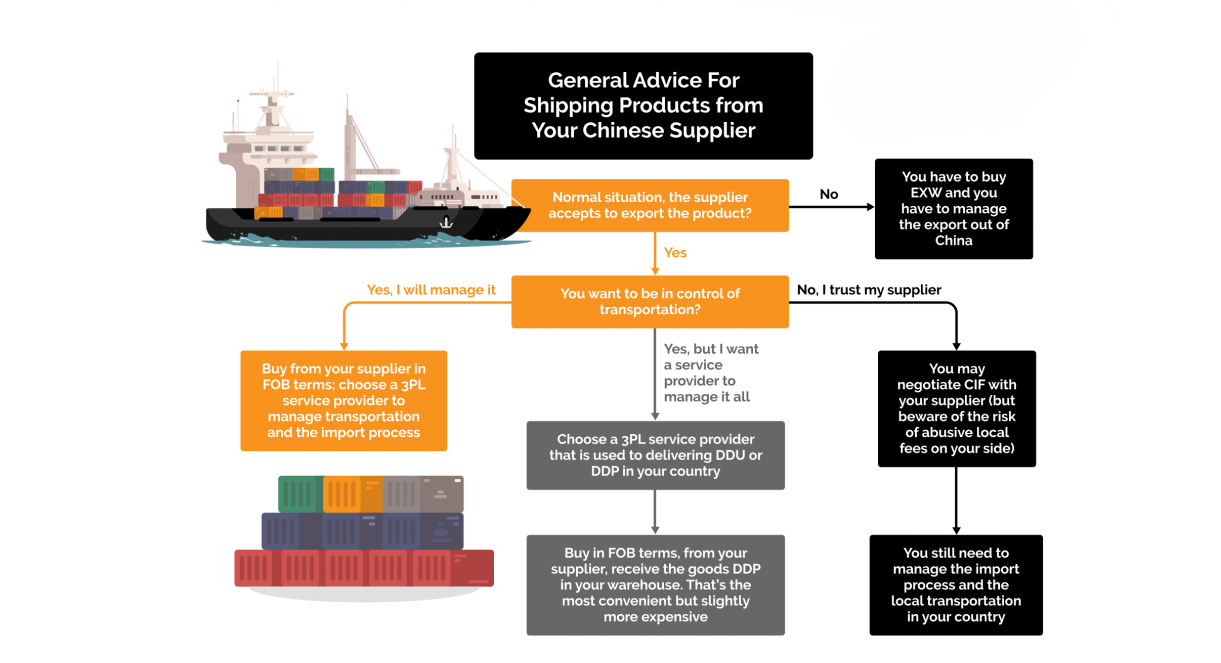
If you have a clear understanding of your trade objectives, it’s entirely feasible to tailor your own International Commercial Terms (Incoterms) for Alibaba trade. The 2020 Incoterms were designed to simplify global transactions by offering a set of standardized terms. However, in reality, the variations and adaptations of these terms are virtually limitless, allowing for customization to suit specific trading needs.
Who Can Help You Manage to Ship from Alibaba, by Yourself, or by an Agent?
When shipping goods from Alibaba, you have several options for managing the logistics, each with its own set of benefits and considerations. Here’s a breakdown:
Shipping by Yourself
- DIY Approach: You can choose to handle the shipping process on your own if you have the expertise and resources. This involves selecting carriers, arranging for pickup and delivery, managing customs clearance, and dealing with any required documentation.
- Benefits: Potentially lower costs if you have negotiated good shipping rates and are familiar with the process. It also offers direct control over the shipping process.
- Considerations: Requires a good understanding of international shipping regulations, customs procedures, and logistics. It can be time-consuming and complex, especially for those new to international trade.
Using Alibaba’s Logistics Services
- Alibaba’s Logistics Partners: Alibaba offers integrated logistics solutions through partnerships with logistics providers. This can be a straightforward option for many buyers, especially using Alibaba’s own platform, such as AliExpress or Alibaba.com Logistics.
- Benefits: Simplified shipping process, as Alibaba’s platform can help automate many steps. Rates can be competitive, and tracking is generally integrated into the platform.
- Considerations: You are somewhat limited to the logistics partners and terms offered by Alibaba, which may not always be the most cost-effective or suitable for your specific needs.
Hiring a Freight Forwarder or Shipping Agent
- Professional Services: Freight forwarders or shipping agents specialize in managing the logistics of shipping goods internationally. They can handle all aspects of shipping, from documentation to customs clearance and delivery.
- Benefits: Expertise in navigating complex international shipping regulations and processes. They can often secure better rates due to their volume of business and may offer more personalized services tailored to your specific needs.
- Considerations: Costs can be higher due to their service fees. It’s important to select a reputable and experienced agent to ensure reliable service.
Choosing the Best Option
- Scale and Experience: If you’re new to international shipping or have a small volume of goods, using Alibaba’s services or hiring a freight forwarder can simplify the process. For experienced traders or those with larger volumes, managing shipping yourself could offer cost savings.
- Cost vs. Convenience: Consider whether the cost savings of managing shipping yourself are worth the time and potential complexities. For many businesses, the convenience and expertise of a freight forwarder justify the extra cost.
- Risk Management: Evaluate how each option manages risks, including delays, damage, and customs issues. Professional shippers and agents may offer more robust solutions for risk management.
Incoterms on Alibaba Conclusion
The updates from the Alibaba Incoterms 2010 to the Incoterms 2020 represent evolutionary rather than revolutionary changes, especially when compared to the significant overhaul seen with the Incoterms 2000 and earlier editions. A notable addition in the 2020 revision is the introduction of the DPU term (Delivered at Place Unloaded), which significantly enhances comprehension of trade responsibilities under the Alibaba Incoterms 2020. This term, among others, is designed to provide clarity and protection for both the seller and buyer, streamlining their roles to facilitate smoother transactions.
The primary goal of implementing these terms is to safeguard the interests of both parties involved in a trade, delineating their obligations clearly to simplify business operations. For those navigating these waters, support is readily available. The China Sourcing Kit is an excellent resource for anyone seeking guidance or assistance in understanding and applying these terms to their manufacturing and shipping strategies.